Tomorrowland’s indoor format, The Magic of Tomorrowland, returned to Shanghai on October 17 and 18 for its second edition, now expanded to two days. The event took place at Hero Dome on the Huangpu riverside. Tomorrowland staged it with Chinese partners Hero Esports and INS LAND. Budweiser is the festival’s global presenting partner. In a post-event release distributed by Hero Esports, the organisers say the show sold out. They give no attendance figure.
The only number so far comes from a Chinese-language report on ifeng’s Dafeng channel, which reads like organiser-supplied copy. It says more than 10,000 people attended on day one, and that 85.6% of them came from overseas or from other Chinese cities. BEZ has not been able to verify either figure independently.
Who played at the Magic of Tomorrowland
Axwell headlined the first night of the Magic of Tomorrowland, according to the organisers and Tomorrowland’s own posts on X. The night also included Lost Frequencies, a back-to-back set from Cassian and Kevin de Vries, MORTEN and Linska, with Chinese DJ Sally opening. The release says Tiësto closed the weekend on night two. It says he followed ARTBAT b2b R3HAB, Miss Monique, Alison Wonderland, Joel Corry and Chinese artist Evin King. A second, smaller stage, Paperworld by Budweiser, hosted sunset sets from Hauzer, Nosi, Bhaskar and Carly Wilford, among others.
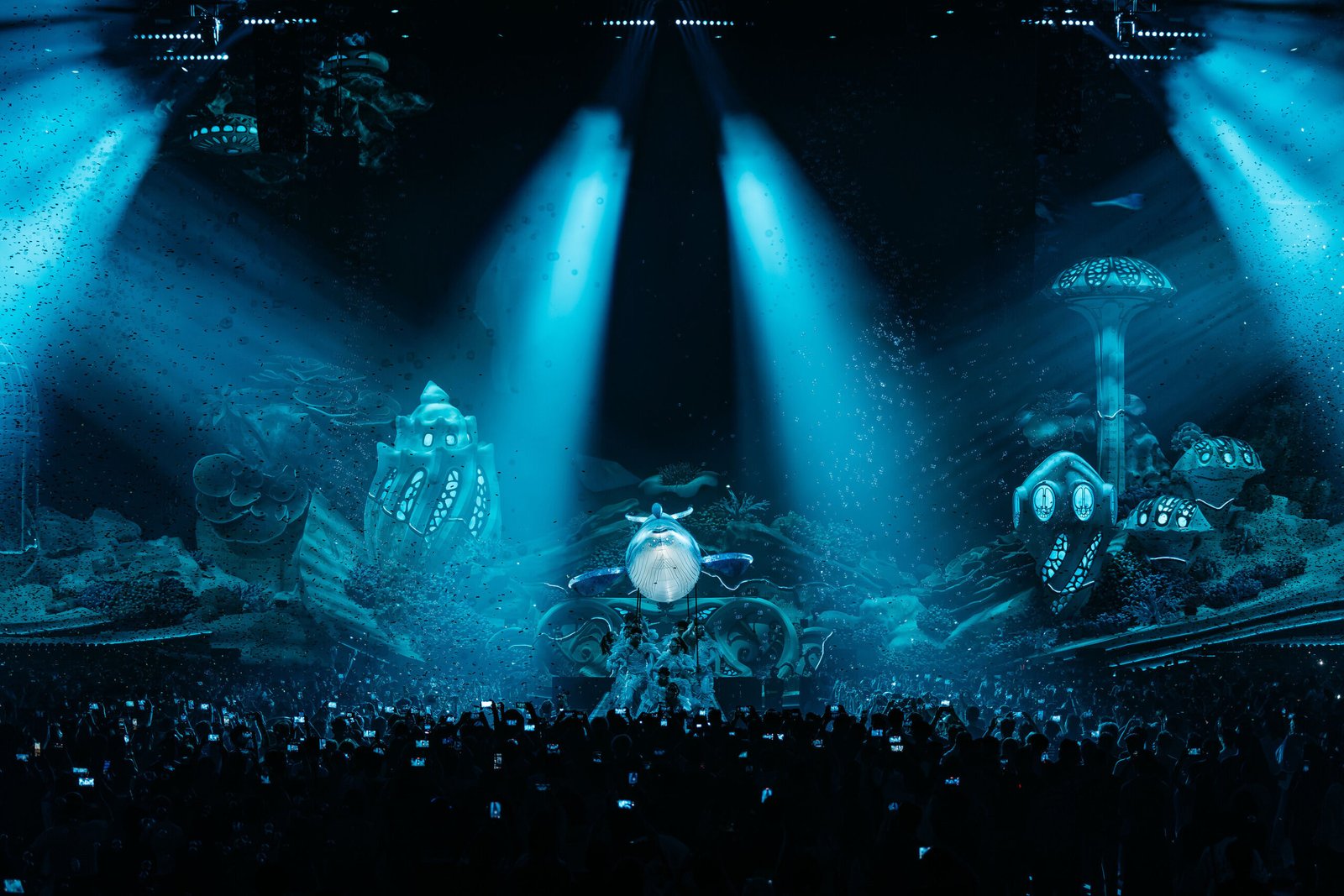
An underwater set, built in China
The main stage used Planaxis, the underwater theme Tomorrowland has used before, with scenography that the organisers say local teams built entirely. In the post-event release the partners list an 88-metre-wide main stage, 72 ceiling screens, 692 moving lights and laser fixtures and 120 L-Acoustics speakers. All of these figures come from the organisers.
“China has always opened its arms to us, and returning for a second year with our local partners is a privilege,” Tomorrowland spokesperson Debby Wilmsen said in the release. Hero Esports CEO and co-founder Danny Tang said the company “can’t wait to bring more of these connecting experiences to China.”
Why it matters
The partners stated the commercial logic more plainly in August, when they announced the lineup. Wilmsen said then that Tomorrowland was “thinking long term” in Shanghai. Tang called the venue upgrade “a long-term commitment,” adding: “This isn’t a one-off event.” The August release also listed ticket prices. It put single-day general admission at ¥788 and two days at ¥1,488, with GA+ at ¥1,288 and ¥2,388.
For the wider industry, the Magic of Tomorrowland shows a European festival brand exported as a self-contained indoor product. The creative direction comes from Belgium, while the venue, production and ticketing are local. The partners have not said how they structure the edition commercially, how they share revenue, or whether they plan a third edition. If they confirm a 2027 date, that will show whether the “long-term” language holds.